Human Trafficking vs. Intimate Partner Violence
By Kailee Shollenberger
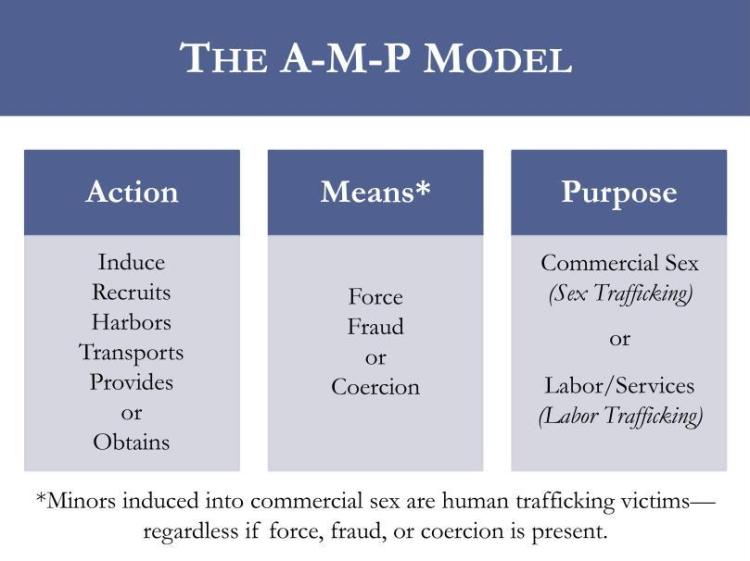
Human trafficking and domestic violence have had long time intersections often making it difficult to distinguish between the two. An individual trafficked by a family member or intimate partner frequently also experiences domestic violence. This domestic violence may become a push factor causing someone’s vulnerability to trafficking. Trafficking in persons has three constituent elements, the first being the act (what is done), the means (how it is done), and the purpose (why it is done)1. The act includes the “recruitment, transportation, transfer, harboring, or receipt of persons.”1 The means includes “threat or use of force, coercion, abduction, fraud, deception, abuse of power, or vulnerability, or giving payments or benefits to a person in control of the victim.”1 The purpose includes “for the purpose of exploitation, which includes exploiting the prostitution of others, sexual exploitation, forced labor, slavery or similar practices, and the removal of organs.”1
The Department of Justice defines domestic violence as “a pattern of abusive behavior in any relationship that is used by one partner to gain or maintain power and control over another intimate partner. Domestic violence can be physical, sexual, emotional, economic, or psychological actions or threats of actions that influence another person. This includes any behaviors that intimidate, manipulate, humiliate, isolate, frighten, terrorize, coerce, threaten, blame, hurt, injure, or wound someone.”2 These definitions are similar, including intersecting forms of experienced violence and abuse.
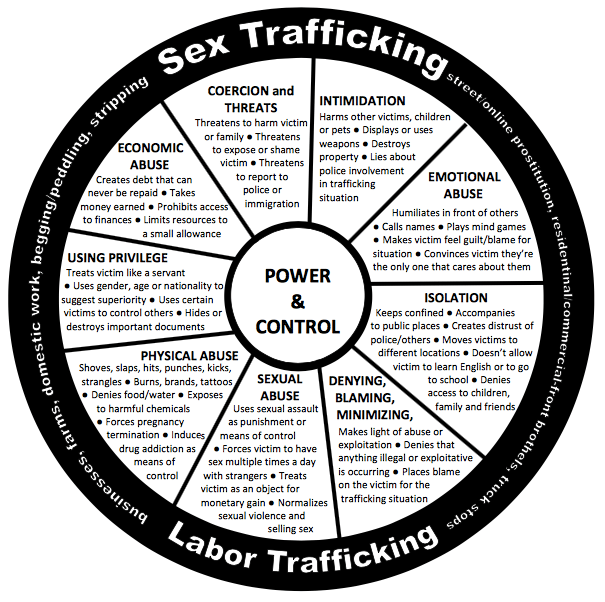
The Polaris Project “Human Trafficking Power and Control Wheel” (below) was adapted from research on domestic violence and emphasizes the shared experiences between trafficking and domestic violence survivors.3 It shows methods traffickers may employ to maintain influence over their victim.
Domestic Violence has been shown to be a “push factor”, which makes individuals more vulnerable to trafficking. Throughout the 1980s, law enforcement officers rarely exercised laws calling for the arrest of men for domestic violence.4Instead, when a woman called for help, officers often “walked the abuser around the block to ‘cool off’ or instructed the woman to leave her residence because her husband legally owned the home.”4 While officers may take domestic violence more seriously now, women are still often left with no choice but to leave their partner. A 2009 U.S. State Department Trafficking in Persons Report found that “almost 70% of adult female trafficking victims experienced domestic violence prior to being trafficked.”3 Also, children exposed to domestic violence in their homes frequently run away in hopes of avoiding abuse; however, runaway homeless youth have been found to be at particular risk of being trafficked. Thus, limited action taken by officers in the past and cultural norms surrounding domestic duties and gender roles in relationships have created a masked the presence of domestic violence, which pushes women and children to run away from their homes increasing their vulnerability to human trafficking.
It is extremely important for us to understand and further explore the intersection between domestic violence and trafficking to raise awareness of the realities faced by victims. Recognizing the intersection between domestic violence and trafficking may enable service providers to better support victims subjected to both human trafficking and domestic violence.
(1) Liam.MCLAUGHLIN. (n.d.). United Nations Office on Drugs and Crime. Retrieved from https://www.unodc.org/unodc/en/human-trafficking/what-is-human-trafficking.html.
(2) Domestic Violence. (2019, May 16). Retrieved from https://www.justice.gov/ovw/domestic-violence.
(3) Cody, H. (2017, November 15). Domestic Violence and Human Trafficking. Retrieved from https://www.unicefusa.org/stories/domestic-violence-and-human-trafficking/33601.
(4) [Excerpt] Cuomo, Dana. (2013). Security and Fear: The Geopolitics of Intimate Partner Violence Policing. 18: 856-874.
Follow My Blog
Get new content delivered directly to your inbox.
 Modern Slavery: Human Trafficking